

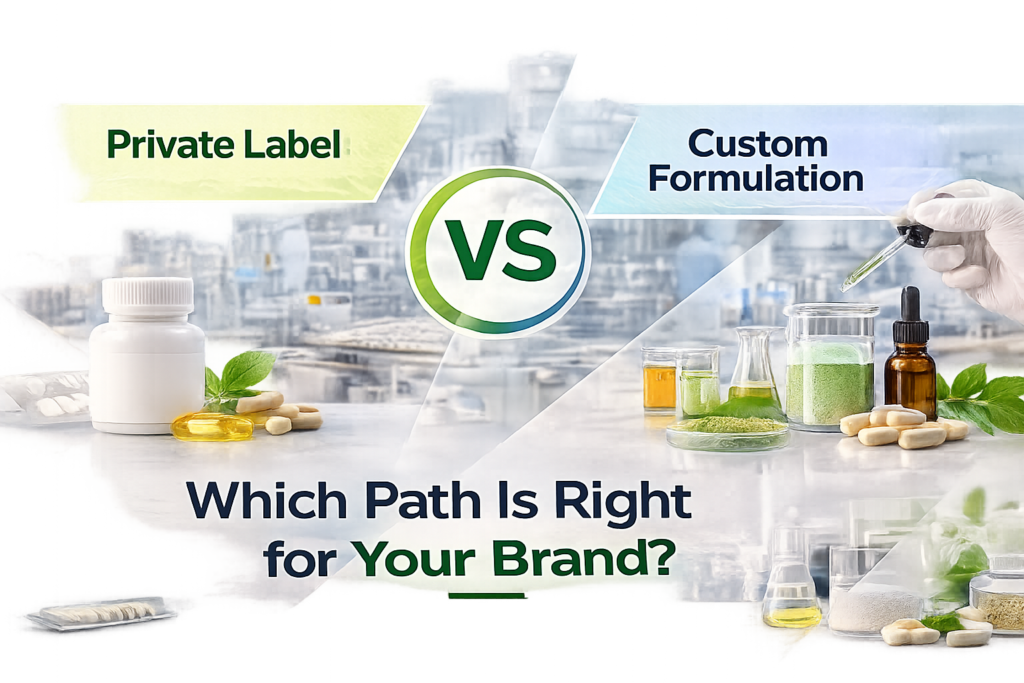
For a nutraceutical brand, choosing how a product will be developed is an important commercial decision. Two common routes are private label manufacturing and custom formulation. Both can lead to commercially viable products, but they differ significantly in development time, investment, flexibility, differentiation, and technical requirements.
For established supplement brands, pharmaceutical companies, distributors, retailers, and wellness businesses, the right choice depends less on which model is “better” and more on what the business is trying to achieve.
A private-label product may be appropriate when speed, proven formulations, and operational simplicity are priorities. Custom formulation can make more sense when a brand requires a specific composition, dosage, positioning, or product specification that an existing formula cannot provide.
Understanding these differences can help procurement and product-development teams choose a manufacturing strategy that fits their commercial objectives.
What Is the Difference Between Private Label and Custom Formulation?
Private label nutraceutical manufacturing generally involves producing a product under a customer’s brand using an existing or established formulation that the manufacturer offers or can manufacture according to agreed specifications.
Custom formulation, by contrast, involves developing or adapting a formulation specifically for the brand. This can include selecting ingredients, determining appropriate levels, optimizing the dosage form, conducting development work, and establishing product specifications before commercial production.
The distinction is important because formulation is closely connected to manufacturing feasibility, quality requirements, testing, packaging, regulatory considerations, and cost.
Private Label vs. Custom Formulation at a Glance
| Factor | Private Label | Custom Formulation |
| Product development | Limited adaptation or existing formula | New or substantially customized development |
| Time to market | Generally shorter | Generally longer |
| R&D involvement | Lower | Higher |
| Product differentiation | Moderate | Higher potential |
| Development investment | Typically lower | Typically higher |
| Flexibility | More limited | Greater |
| Suitable for | Fast market entry and established product concepts | Specific product concepts and differentiation |
These are general business considerations; the actual process, cost, and timeline depend on the product and manufacturer.
When Does Private Label Manufacturing Make Sense?
Private label can be an efficient route for businesses that want to launch or expand a product portfolio without investing heavily in formulation development.
For example, a distributor or established wellness brand may already know that it wants to add a particular vitamin, mineral, herbal, or combination supplement to its portfolio. If a suitable formulation already exists and meets the business’s target specifications, private label manufacturing can reduce development complexity.
Private label may be particularly suitable when:
- Speed to market is a major priority
- The product concept is already well established
- The business does not require a highly differentiated formulation
- Initial R&D investment needs to be controlled
- The buyer wants to expand an existing product range
- Demand and specifications are relatively predictable
However, private label should not mean accepting a product without appropriate technical and quality review. Businesses should still assess ingredient specifications, dosage, testing, packaging, labeling, regulatory requirements, and manufacturing controls.
When Is Custom Formulation the Better Option?
Custom formulation becomes more valuable when an existing product does not meet the brand’s technical or commercial requirements.
A company may want a specific combination of ingredients, a particular dosage form, different serving characteristics, or a formulation designed around a defined product specification.
Custom formulation can support:
- Product differentiation
- Proprietary or brand-specific specifications
- Specific ingredient combinations
- Targeted dosage-form requirements
- Reformulation of an existing product
- Optimization of manufacturing characteristics
- Long-term product development strategies
The process can require substantially more technical input. Product developers and manufacturers may need to consider ingredient compatibility, stability, processing characteristics, sensory properties, excipients, packaging, and testing requirements.
This is why product formulation and R&D should be considered part of the manufacturing strategy rather than an isolated step.
Cost, MOQ, and Time-to-Market Considerations
The decision between private label and custom formulation is also a financial one.
Private label generally involves less development work because the underlying product concept or formulation already exists. This can reduce development complexity and potentially shorten the path to commercial production.
Custom formulation usually requires additional work before manufacturing can begin. Depending on the product, this may involve formulation development, sample iterations, testing, stability considerations, specification development, and scale-up.
However, businesses should avoid evaluating the two models purely on initial cost.
A more useful calculation considers the total commercial value of the product, including:
- Development and formulation costs
- Manufacturing cost
- Packaging
- Testing and quality control
- Minimum order requirements
- Inventory investment
- Expected selling price
- Product differentiation
- Reordering requirements
- Regulatory and market-entry considerations
A lower development cost is not necessarily the better business decision if the resulting product is difficult to differentiate in a competitive market.
Quality and Regulatory Considerations Apply to Both
Whether a product is private label or custom formulated, quality management remains fundamental.
WHO describes GMP as a quality-assurance system intended to ensure that products are consistently produced and controlled according to appropriate quality standards. GMP encompasses defined and documented production and quality-control processes, suitable personnel and facilities, and appropriate controls over materials and manufacturing activities.
For businesses evaluating private label nutraceutical manufacturers or custom manufacturing partners, this means looking beyond the formulation itself.
Ask potential manufacturers about:
- Raw-material qualification and testing
- Product specifications
- Quality-control procedures
- Batch documentation
- Finished-product testing
- Traceability
- Change-control procedures
- Packaging and labeling controls
- Applicable regulatory documentation
The exact requirements depend on the product category and destination market. Export products may also require additional documentation or country-specific compliance work.
Ingredient Sourcing and Formulation Feasibility Matter
A formulation that looks attractive on paper may not automatically be straightforward to manufacture at commercial scale.
Ingredient availability, specification consistency, compatibility, processing behavior, and supply continuity can all affect product development.
For custom products, manufacturers should evaluate whether the proposed formulation can be produced consistently and whether appropriate specifications and testing methods can be established.
This is one reason an experienced nutraceutical manufacturer can add value early in the development process. Technical feasibility should be considered before a business commits significant resources to packaging, inventory, or market launch.
Common Mistakes Brands Make
Choosing custom formulation simply for differentiation
Customization does not automatically create a stronger product. A custom formula should solve a meaningful product, technical, or commercial requirement.
Choosing private label solely because it is faster
Speed is valuable, but the selected formulation still needs to match the brand’s quality, positioning, market, and regulatory requirements.
Focusing only on unit price
Development, testing, packaging, MOQ, inventory, logistics, and supply continuity all affect the total economics.
Ignoring scale-up
A formula that performs well during development needs to be suitable for consistent commercial manufacturing. Scale-up should therefore be considered early.
Treating regulatory requirements as an afterthought
Product composition, claims, labeling, packaging, and market requirements should be considered before finalizing the manufacturing pathway.
How Should You Decide Between Private Label and Custom Formulation?
A practical decision framework is to ask five questions:
- Do we need a unique product?
If an existing formulation meets your commercial and technical requirements, private label may be sufficient. If not, investigate customization. - How important is speed to market?
A private-label route may be more appropriate when launch timing is critical. - What level of differentiation does the brand require?
Custom formulation offers greater control over product specifications. - What is the expected demand?
Forecast volume, MOQ, inventory requirements, and manufacturing scalability should influence the decision. - What technical support does the project require?
If formulation development, optimization, or scale-up is necessary, select a manufacturer with appropriate R&D capabilities.
For many businesses, the answer is not entirely one or the other. A manufacturer may offer an existing formulation that can be adapted to meet specific brand requirements, creating a middle ground between standard private label and completely new product development.
Why the Right Nutraceutical Manufacturing Partner Matters
The manufacturer you choose can influence both pathways. A capable partner should be able to explain what is already available, what can be customized, what development work is required, and how the product can transition into commercial production.
Cosmo Pharma supports B2B businesses with private-label nutraceutical manufacturing, custom formulation and R&D, contract manufacturing, third-party manufacturing, packaging support, and export manufacturing. This allows businesses to discuss their product requirements before determining the most appropriate manufacturing route.
For procurement and product-development teams, the objective should be to select the pathway that balances differentiation, development investment, quality, regulatory requirements, scalability, and time to market.
Frequently Asked Questions
Is private label cheaper than custom formulation?
Private label can have lower development costs because it may use an existing formulation. However, total product economics also depend on MOQ, manufacturing, packaging, testing, inventory, and other project-specific requirements.
Is custom formulation better for an established supplement brand?
Not necessarily. Custom formulation can be valuable when differentiation or specific product requirements are important. If an existing formulation already meets the brand’s specifications, private label may be more efficient.
How long does custom nutraceutical formulation take?
There is no universal timeline. Development time depends on formulation complexity, ingredients, dosage form, testing, revisions, specifications, and the requirements of the target market.
Can a private-label formula be customized?
Depending on the manufacturer’s capabilities and the formulation, some products can be adapted. The extent of customization should be established during technical discussions before production.
Which option is better for export markets?
Neither option is automatically better. The appropriate choice depends on the destination market, product requirements, regulatory considerations, documentation, and the brand’s commercial strategy.
Conclusion
The choice between private label and custom formulation should be driven by business objectives rather than the assumption that one manufacturing model is universally superior.
Private label can provide a practical route for brands prioritizing speed, established formulations, and simpler product development. Custom formulation can provide greater control when differentiation, specific specifications, or unique product requirements are central to the strategy.
The most important step is to work with a nutraceutical manufacturing partner that can evaluate the technical and commercial requirements of your project objectively.
If you are deciding between private-label manufacturing and custom product development, Cosmo Pharma International can help you discuss your formulation requirements, manufacturing objectives, and preferred route to commercial production.